
Commentary – Fourth Quarter 2025
November 23, 2025Commentary – Fourth Quarter 2025
November 23, 2025
INSIGHTS
The Science Behind Optimal Portfolio Construction
Most investors assume the rule is simple: higher returns mean higher risk, full stop. For most of the last several decades, that's been true. Right now, it isn't, and understanding why is the key to building a portfolio that actually fits what you need it to do.
What "Optimal" Actually Means
Portfolio construction, done properly, is a function of what's called mean-variance theory. In plain English: for any level of risk you're willing to take, there's a version of your portfolio that gets you the most return the market is willing to give you for that risk. Take on more risk than that, and you're not getting paid for it. Take on less, and you're leaving potential return on the table.
On a graph of risk versus return, that sweet spot shows up as an inflection point: the place where you're extracting the maximum return per unit of risk before the curve starts declining.
Think of it the way you'd think about buying a car. Nobody walks onto a lot and deliberately chooses the least fuel-efficient option available. You want the most miles for every gallon you put in the tank. Optimal portfolio construction is the same idea applied to your investments: the most return for every unit of risk you're taking on.
Why the Math is Unusual Right Now
Here's what makes today's environment worth paying attention to: you can get the same level of return with about a quarter of the risk that same return has historically required.
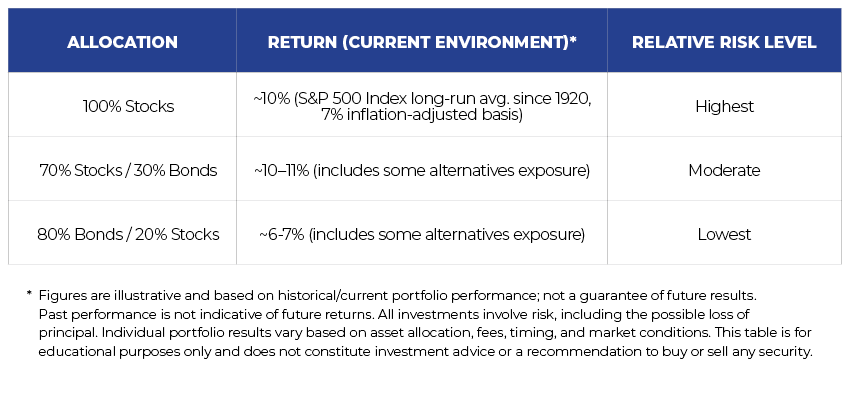
Some context. The S&P 500 has averaged roughly 10% a year since 1920 in nominal terms (closer to 7% after inflation). That’s the long‑run benchmark most people have in mind when they think about “what stocks return.”
Right now, portfolios with only 20–30% bond exposure can generate nominal returns in that same range, historically a stock‑like result, but with a fraction of the volatility an all‑equity portfolio would require.
That reshapes how you should think about portfolios that look, on paper, more conservative. A mix closer to 70% stocks and 30% bonds has been earning 10–11% in this environment. On its own, that’s an excellent long‑term number—the kind of return that would have been considered outstanding in almost any prior decade. But measured against a red‑hot S&P 500, it can look subpar. That’s a distortion, not a reflection of the portfolio underperforming. The comparison itself is misleading.
Put simply: today, you can get meaningfully more return for a given level of risk than you've been able to in the last 20 to 30 years.
Why This Window Exists
Where interest rates and the yield curve sit right now, bonds are doing more of the work than they have in decades. Higher rates mean the bond side of a portfolio is generating a return level that, for much of the last generation, only stocks could reliably provide. That's the mechanical reason a more conservative mix can produce a less-conservative-looking result. Further, should rates come down overall, there is another bump to return from appreciation. However, should rates stay elevated for a long period of time, you get paid to wait with a healthy income return.
The Framework Behind It
This isn't theory pulled from a textbook. It's the same discipline used to manage some of the world's largest pools of capital, applied here to individual client portfolios.
Earlier in his career, Tom spent years allocating hundreds of millions of dollars, work that built lasting relationships across the institutional investing world. That's the caliber of thinking behind how portfolios at Eamon Capital Management are built: not guesswork or a generic model, but the same risk-efficiency framework used at the institutional level.
The Takeaway
Optimal portfolio construction was never about chasing the highest possible return. It's about making sure you're getting the most return for the risk you're actually taking: no more risk than you're being compensated for, and no less return than your risk level should be earning you.
If you haven't had your portfolio's risk-adjusted efficiency reviewed recently, it's worth a conversation, especially in a market environment like this one, where the math has shifted in your favor.
Connect with us at info@eamoncap.com and take control of your financial future.
Eamon Capital Management, LLC (“Eamon”) is a registered investment advisor offering advisory services in the State of Pennsylvania and in other jurisdictions where exempted. Registration does not imply a certain level of skill or training.
This communication is for informational purposes only and is not intended as tax, accounting or legal advice, as an offer or solicitation of an offer to buy or sell, or as an endorsement of any company, security, fund, or other securities or non-securities offering. This communication should not be relied upon as the sole factor in an investment making decision.
Past performance is no indication of future results. Investment in securities involves significant risk and has the potential for partial or complete loss of funds invested. It should not be assumed that any recommendations made will be profitable or equal the performance noted in this publication.
The information herein is provided “AS IS” and without warranties of any kind either express or implied. To the fullest extent permissible pursuant to applicable laws, Eamon Capital Management, LLC (referred to as “Eamon”) disclaims all warranties, express or implied, including, but not limited to, implied warranties of merchantability, non-infringement, and suitability for a particular purpose.
All opinions and estimates constitute Eamon’s judgement as of the date of this communication and are subject to change without notice. Eamon does not warrant that the information will be free from error. The information should not be relied upon for purposes of transacting securities or other investments. Your use of the information is at your sole risk. Under no circumstances shall Eamon be liable for any direct, indirect, special or consequential damages that result from the use of, or the inability to use, the information provided herein, even if Eamon or a Eamon authorized representative has been advised of the possibility of such damages. Information contained herein should not be considered a solicitation to buy, an offer to sell, or a recommendation of any security in any jurisdiction where such offer, solicitation, or recommendation would be unlawful or unauthorized.